
IPv4 vs IPv6 – What’s the Difference and Why It Matters
When you open a website or send a message, your device uses the Internet Protocol (IP) to identify itself and communicate with other systems. IPv4 vs IPv6 refers to two different versions of this protocol. IPv4 has powered the internet for more than three decades. However, the world is now moving toward IPv6. In this article, you will learn what IPv4 and IPv6 are, how they are different, and why this change matters.
IPv4 vs IPv6 – Understanding the Basics
IPv4 stands for Internet Protocol Version 4 and is the older version of the protocol.
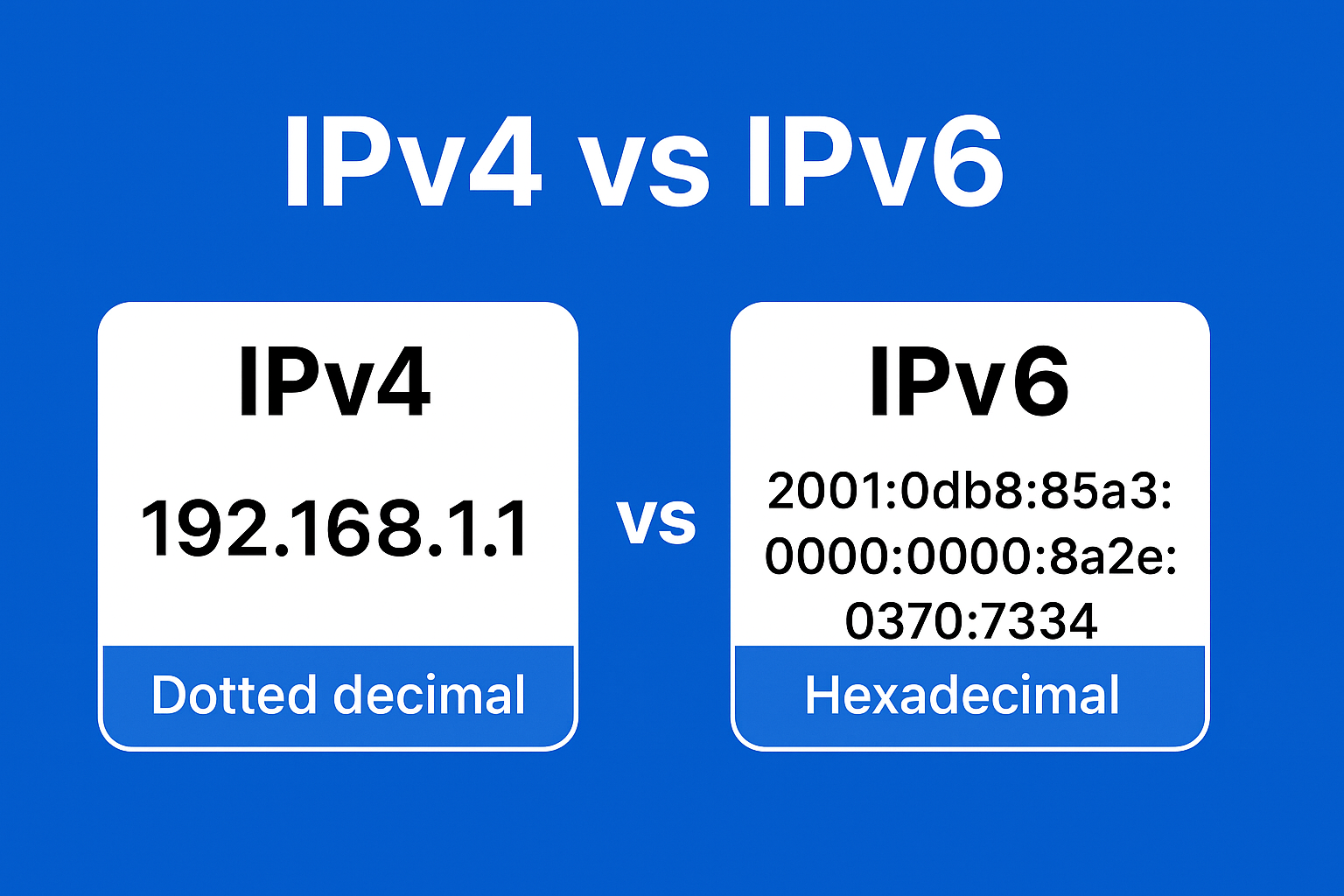
It uses a 32-bit address, which is usually written in a dotted-decimal format such as 192.168.1.1. Because of this structure, IPv4 can only provide 4.3 billion addresses.
This sounded like a lot in the early years of the internet. However, with the rapid growth of smartphones, computers, smart home devices, and IoT systems, all IPv4 addresses have almost been used up.
IPv6, on the other hand, uses a 128-bit address and is written in a hexadecimal format with colons. For example: 2001:0db8:85a3:0000:0000:8a2e:0370:7334.
Due to its structure, IPv6 offers 340 undecillion unique addresses, which is more than enough for many generations to come.
Key Differences Between IPv4 vs IPv6
| Feature | IPv4 | IPv6 |
|---|---|---|
| Address Length | 32-bit | 128-bit |
| Format | Dotted-decimal | Hexadecimal (with colons) |
| Number of Addresses | 4.3 Billion | 340 Undecillion |
| Security | Optional IPsec | IPsec by default |
| Efficiency | Uses NAT | No NAT, faster |
| Configuration | Manual or DHCP | Auto-configuration built-in |
Why IPv4 vs IPv6 Difference Matters
First of all, IPv6 solves the address shortage problem completely. With IPv6, we can give a unique IP address to every device on earth.
Furthermore, IPv6 improves performance and reduces the need for complex workarounds like NAT (Network Address Translation).
Because IPv6 allows direct device-to-device communication, services such as video calls and online gaming work more smoothly.
In addition, IPv6 offers better security because IPsec is built-in. IPv4 can also support IPsec, but it is optional and therefore rarely used in basic environments.
What is NAT and Why It Was Used Before IPv6
Network Address Translation (NAT) is a method that allows multiple devices in a private network to share one public IPv4 address. This helped slow down the exhaustion of IPv4 addresses and allowed millions of home networks to stay online.
However, NAT adds complexity and sometimes reduces performance. Because IPv6 gives every device its own public IP address, this workaround is no longer necessary.
🔗 Related article on nowtech.in:
What is FTTH? Explained for Beginners (internal link)
🌐 Learn more about IPv6 on the official IETF website:
https://www.ietf.org/standards/ (outbound link)
Conclusion: IPv4 vs IPv6 – Which One Is Better?
To conclude, IPv4 vs IPv6 is not just a comparison. It shows how the internet is evolving to support billions of devices and improve security at the same time. IPv4 still works and will remain in use for many years. Nevertheless, IPv6 is the only protocol that can support the future growth of the internet.
If you are building networks or managing systems, adopting IPv6 is a smart and future-ready step.
For everyday users, the switch happens in the background, although it still brings faster and more secure connections.