

Decoding OLT, ONU, ONT, and ODN in PON Network
PON Network Components are key elements that allow fiber-optic broadband to reach homes and businesses efficiently. In a Passive Optical Network (PON), there is no active electronic device between the provider and the user. Instead, the network relies on specific components such as OLT, ONU, ONT, and ODN to transmit data using optical signals.
In this article, we will explain each component in a simple way so beginners can clearly understand how a PON network works.
What Is a PON Network?
A Passive Optical Network (PON) is a fiber-optic access technology that delivers high-speed internet from an Internet Service Provider (ISP) to end users. The network uses optical splitters and passive components to distribute the signal. As a result, it is cost-efficient, scalable, and requires very little maintenance.
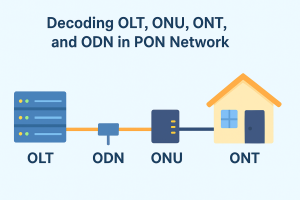
Main PON Network Components
1. OLT (Optical Line Terminal)
An OLT is installed at the provider’s central office.
Its main functions are:
-
Converting electrical signals into optical signals
-
Managing upstream and downstream traffic
-
Controlling multiple ONUs / ONTs at the user end
In short, the OLT acts as the brain of the PON network.
2. ODN (Optical Distribution Network)
The ODN is the physical infrastructure that connects the OLT to the end users. It includes the following:
-
Fiber-optic cables
-
Splitters (1:4, 1:8, 1:16, etc.)
-
Distribution boxes and joints
The ODN distributes the optical signal from a single fiber coming out of the OLT to many users. Therefore, it plays a crucial role in making fiber connections cost-efficient.
3. ONU (Optical Network Unit)
An ONU is a device that receives the optical signal from the OLT (through the ODN) and converts it back into an electrical signal. In some cases, an ONU serves multiple users in an apartment building or local area.
It can also perform other tasks such as:
-
Buffering the data
-
Traffic shaping
-
Ethernet conversion
4. ONT (Optical Network Terminal)
An ONT is basically the customer-side version of the ONU. It is installed inside the customer’s premises and connects directly to a router or Wi-Fi device. It converts the optical signal into usable internet access for end devices (PCs, phones, TVs, etc.).
Difference between ONU and ONT:
| Aspect | ONU | ONT |
|---|---|---|
| Location | Outside / distribution point | Inside the customer’s home |
| Users Served | One or multiple | One subscriber |
| Role | Converts and distributes signals | Converts signal for use by one user |
Why These PON Network Components Matter
Understanding these fiber components is essential because:
-
It helps technicians design and maintain reliable FTTH networks
-
It allows service providers to scale the network using passive infrastructure
-
It reduces power consumption and maintenance costs
-
It increases broadband availability in both urban and rural areas
In addition, PON networks are preferred by most modern ISPs because they support gigabit internet speeds using a simple and efficient design.
For a deeper technical reference, you can also check the guide from the ITU (International Telecommunication Union): https://www.itu.int/rec/T-REC-G.984
FAQ – Frequently Asked Questions
Q1. What are the basic components of a PON Network?
The basic PON Network Components are OLT, ODN, ONU, and ONT.
Q2. Is OLT installed at the customer side?
No. The OLT is installed at the service provider’s central office.
Q3. What is the purpose of a splitter in the ODN?
The splitter divides one optical signal into multiple paths to serve several end users.