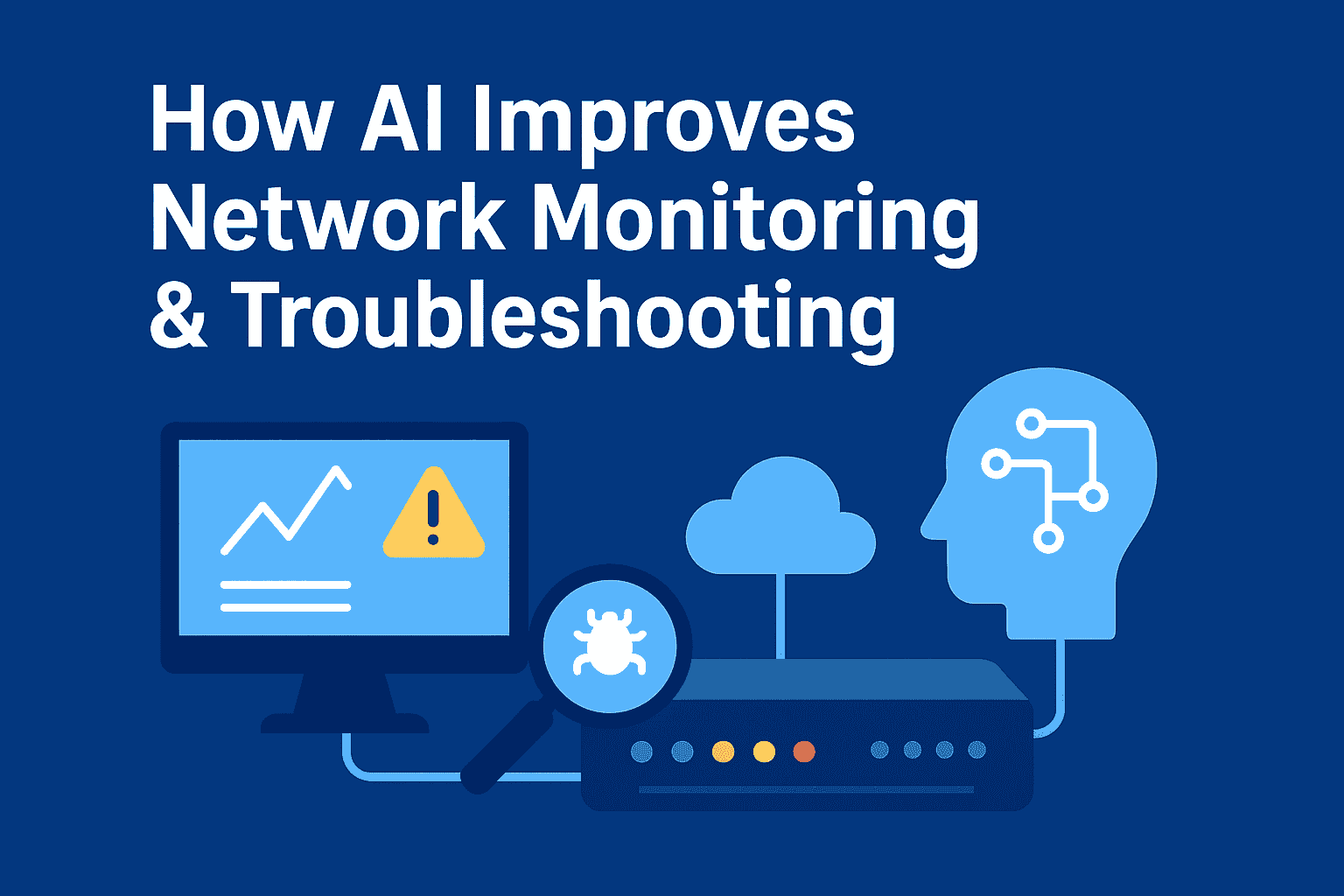
How AI Improves Network Monitoring & Troubleshooting
In today’s digital world, AI in network monitoring and troubleshooting is becoming more critical than ever. Businesses, ISPs, and even home users depend on stable networks for daily operations. This is where Artificial Intelligence (AI) is transforming the way we manage, monitor, and troubleshoot networks. By automating processes, detecting issues faster, and reducing downtime, AI makes network monitoring smarter and more efficient.
Why Traditional Network Monitoring Has Limitations
Traditional tools rely on manual configuration, SNMP traps, and static alerts. While these methods work, they often fail to detect complex issues or predict failures in advance. For example, if bandwidth spikes suddenly, an admin may not immediately know the root cause. This leads to longer troubleshooting times and potential outages.
👉 Read our beginner-friendly guide on What is FTTH? to understand how modern networks are evolving with fiber optics.
How AI Improves Network Monitoring & Troubleshooting
AI introduces automation and predictive analytics into network monitoring. Here’s how it makes a difference:
-
Anomaly Detection – AI can analyze network traffic patterns in real-time. If unusual activity is detected (like a sudden surge in latency or packet loss), it alerts admins before users experience problems.
-
Predictive Maintenance – Instead of reacting to failures, AI predicts when a device or link may fail. This helps ISPs and enterprises prevent costly downtime.
-
Automated Root-Cause Analysis – AI tools like Cisco’s AI-driven monitoring can identify the exact cause of network problems within seconds.
-
Faster Troubleshooting – By correlating logs, metrics, and alerts, AI eliminates the guesswork, allowing admins to focus on fixing instead of searching.
AI in Network Troubleshooting: Real-World Applications
-
ISPs and Fiber Networks: AI helps track ONUs, OLTs, and GPON performance automatically. For example, if signal levels drop in an FTTH network, AI tools can instantly detect and suggest corrective actions.
-
Enterprise Networks: AI-driven platforms like IBM Watson AIOps and Juniper Mist use machine learning to troubleshoot Wi-Fi and LAN issues automatically.
-
Cybersecurity Monitoring: AI can identify suspicious traffic (possible DDoS attacks or malware activity) and isolate it before damage occurs.
👉 Check out our detailed guide on Difference Between GPON and EPON to see how AI can improve these fiber technologies.
Benefits of AI for Network Teams
-
Reduced Downtime – Faster detection and prevention of issues.
-
Better User Experience – Stable internet with fewer interruptions.
-
Lower Operational Costs – Less manual work and fewer outages.
-
Scalability – AI can manage complex networks without requiring huge IT teams.
Future of AI in Networking
As networks grow more complex with IoT, 5G, and cloud services, AI in network monitoring and troubleshooting will play a bigger role in automation. Soon, AI may handle self-healing networks where devices fix themselves without human intervention.
For a deep dive, you can explore Juniper’s AI-driven enterprise solutions.
Conclusion
AI is not just a buzzword—it’s reshaping network monitoring and troubleshooting. From predictive maintenance to automated root-cause analysis, AI reduces downtime, improves efficiency, and keeps networks future-ready.
👉 Want to start your own ISP with modern AI-powered monitoring? Read our step-by-step guide on How to Start ISP Business.