
How to Start ISP Business – Step-by-Step Guide for Beginners
How to Start ISP Business is a common question asked by many tech entrepreneurs who want to enter the growing internet industry. An Internet Service Provider (ISP) delivers internet connectivity to homes and businesses using various access technologies such as fiber, wireless or cable. Starting your own ISP can be profitable, but it requires planning, licensing, infrastructure and good customer support.
In this guide, we explain the major steps required to start an ISP business globally in a simple and practical manner.
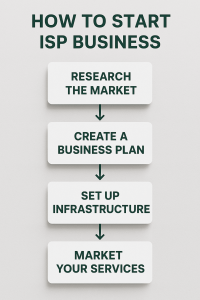
1. Understand the ISP Business Model
Before launching an ISP business, it is important to understand how the ISP business model works. In most cases, you will buy internet bandwidth from a larger upstream provider or carrier and then distribute that bandwidth to local customers using your own access network.
There are two types of ISPs:
-
Tier-2 / Tier-3 ISPs – buy bandwidth from other providers and resell it (this is the most common model for startups).
-
Tier-1 ISPs – own their own global backbone (very large operators).
Most people who want to start ISP business begin as Tier-2 or Tier-3 in a local or regional area.
2. Check Licensing and Regulatory Requirements
Next, you need to check your country’s telecom regulations and licensing requirements.
Most governments require an ISP to apply for an official telecommunication license before operating.
For example:
| Region | License Name |
|---|---|
| USA | FCC ISP Registration |
| Europe | National Telecom Authority licensing |
| India | Class A / B ISP License |
| Middle East | National telecom regulatory authority license |
👉 Visit your national telecom regulator’s website to read eligibility conditions, application forms, fee structure and compliance requirements.
3. Get Bandwidth From an Upstream Provider
Once your license is approved (or application is in process), you need to purchase dedicated internet bandwidth from an upstream provider or carrier.
Large Tier-1 ISPs, data centers or carrier hotels usually sell bulk bandwidth on fiber or Ethernet connections. You can start with a lower capacity (e.g., 1 Gbps) and upgrade as your customer base grows.
4. Choose the Right Access Technology
To distribute bandwidth to customers, you must build an access network. There are different technologies you can choose from:
| Technology | Description |
|---|---|
| FTTH (Fiber to the Home) | Fiber to end user, high speed, long-term |
| Wireless (PtP / PtMP) | Quick to deploy, good for rural or urban areas |
| Cable / Coax | Uses existing coax infrastructure |
| Hybrid | Mix of fiber and wireless |
Choose the option that best fits your service area, budget and target market.
5. Deploy Network Infrastructure
This involves installing:
-
Core routers and switches (at your data center or network hub)
-
Access devices (OLT/ODN/ANT for fiber or base stations for wireless)
-
Customer-premises equipment (ONU/ONT or Wi-Fi router at user end)
-
Network monitoring and billing systems
Start small and keep the network scalable, so you can add capacity as your business grows.
6. Build a Customer Service and Support Process
Reliable internet service is important, but good customer support is equally important.
Create a support system that includes:
-
Phone / WhatsApp support
-
Trouble ticket system
-
Field staff for on-site issues
Clear and responsive support helps build trust and reduces customer churn.
7. Launch and Market Your ISP Service
After building your network and support process, it’s time to launch your ISP service:
-
Choose attractive plans and pricing
-
Offer promotional packages for the first months
-
Use online marketing, social media and local advertising
-
Highlight key advantages like fiber connectivity, low latency, 24×7 support, etc.
For inspiration and global best practices, you can check:
https://www.fcc.gov/isp and https://www.itu.int
Final Thoughts
Starting an ISP business can seem complex, but by following the right steps — licensing, purchasing bandwidth, building infrastructure, and delivering excellent customer support — you can successfully launch your own internet service. With increasing demand for high-speed connectivity around the world, this is a great time to enter the ISP market.