
What is Routing in Networking?
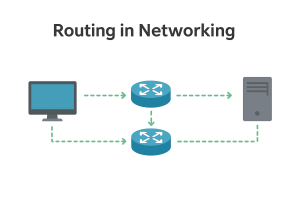
Routing in networking is the process of selecting the best path for data to travel across interconnected networks. When a device sends packets from one point to another, it does not automatically know where to go. Instead, routing helps the packets reach their final destination by choosing the shortest and most efficient path.
How Does Routing Work?
Whenever a packet leaves your device, it first reaches the nearest router. Next, the router checks the packet’s IP address and searches its routing table. This table contains information about known networks and the next hop for each destination.
Then, the router forwards the packet using the most efficient route. Furthermore, if the packet needs to cross several routers, each router repeats this process until the packet finally reaches its destination network.
This entire task takes place in milliseconds. As a result, websites and online services load quickly and without interruption.
Routing Methods
There are two primary methods used in networking:
| Method | Description |
|---|---|
| Static Routing | The network administrator manually defines routes. It is useful for smaller networks. |
| Dynamic Routing | Routers use protocols to discover and maintain the best routes automatically. Ideal for larger networks. |
Popular Dynamic Routing Protocols
Modern routers use different protocols depending on the network size:
-
RIP (Routing Information Protocol) – A simple, distance-vector protocol used in smaller environments.
-
OSPF (Open Shortest Path First) – A link-state protocol often seen in large enterprise networks.
-
EIGRP (Enhanced Interior Gateway Routing Protocol) – Cisco’s proprietary hybrid protocol.
-
BGP (Border Gateway Protocol) – Used between Internet Service Providers (ISPs); it is the backbone of the internet.
For a deeper look at BGP, you can read: https://www.cloudflare.com/learning/network-layer/what-is-bgp/
Importance of Routing in Modern Networks
Routing plays a vital role in networking infrastructure. In fact, it ensures that packets reach their destination quickly and reliably. Here are a few important benefits:
-
Ensures reliable delivery of data
-
Improves network performance due to optimized paths
-
Supports real-time services, such as VoIP and video streaming
-
Promotes scalability and smooth network expansion
-
Prevents congestion by automatically choosing alternate paths
Without proper routing, packets could get dropped or travel through inefficient routes, which would lead to slow performance and packet loss.
Routing vs Switching – What’s the Difference?
| Feature | Switching | Routing |
|---|---|---|
| Works on | Layer 2 (Data Link) | Layer 3 (Network) |
| Uses | MAC addresses | IP addresses |
| Scope | Within a local network (LAN) | Between different networks (LAN to WAN) |
| Device | Switch | Router |
In short, switches forward traffic inside a single network, while routers direct traffic between multiple networks.
Types of Routes
Here are the most common types of routes you’ll find in modern networks:
-
Directly Connected Route – The destination exists on one of the router’s interfaces.
-
Static Route – An administrator manually configures this route.
-
Default Route – Used when no specific route is available in the routing table.
-
Dynamic Route – Learned automatically through routing protocols.
If you want to explore more details on route types and routing tables, you can visit:
https://www.practicalnetworking.net/series/routing/what-is-routing/
FAQ – Frequently Asked Questions
Q1. Is routing only used on the internet?
No. Routing is also used in private enterprise networks, data centers and cloud networks.
Q2. Can routing happen without a router?
No. Routing requires a routing-capable device such as a router, firewall or layer-3 switch.
Q3. What happens if a route is not found by the router?
In that case, the router either forwards the packet to a default gateway (if available) or drops it.