
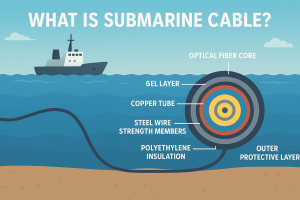
What is Submarine Cable? A submarine cable is a long fiber-optic cable laid under the ocean to transmit data between different continents and countries. Instead of using satellites, most of the world’s internet traffic travels through these underwater cables because they provide faster and more reliable communication.
Introduction to Submarine Cables
In simple words, submarine cables act like highways for the internet. They connect regions across the globe and carry voice, video, and data signals between major data centers. Because of this, people can browse websites, stream videos, and make VoIP calls with low delay across long distances.
How Does a Submarine Cable Work?
A submarine cable uses fiber-optic technology, which means it sends information in the form of light signals. As a result, data can travel extremely fast through glass fibers inside the cable.
The cable is protected by several layers such as steel, copper and waterproof insulation. These layers help the cable stay safe from water pressure and physical damage.
When a cable reaches the coast, it connects to a landing station and continues as a terrestrial fiber link to internet exchange points and service providers.
Therefore, submarine cables play an essential role in the smooth operation of global communication systems.
Types of Submarine Cables
| Type of Cable | Description |
|---|---|
| Repeatered Cable | Contains electronic repeaters that boost the signal across long distances. |
| Unrepeatered Cable | Used for shorter distances and does not include repeaters. |
Importance of Submarine Cables
Submarine cables provide many benefits to modern communication networks. Here are a few reasons why they are so important:
-
Fast data transfer: Fiber-optic cables offer very high bandwidth and low latency.
-
Reliable connectivity: They provide more stable connections compared to satellites.
-
Global reach: These cables connect different countries around the world.
-
Support cloud services: They help businesses access cloud applications quickly.
-
Scalability: New cables can be installed to handle increasing data requirements.
Besides this, most telecom operators and internet service providers rely on submarine cables to deliver data to end users.
How Submarine Cables Are Installed
Installing a submarine cable usually follows a step-by-step process:
-
Planning and route survey – Engineers choose a safe and stable path on the seabed.
-
Manufacturing the cable – The cable is designed and built according to the required distance.
-
Laying the cable – Special ships carefully place the cable on the sea floor.
-
Testing and activation – The cable is tested for performance and then put into service.
In addition, cable routes are often monitored and maintained to avoid damage from fishing, anchors or underwater landslides.
Submarine Cable vs Satellite Communication
| Feature | Submarine Cable | Satellite Communication |
|---|---|---|
| Latency | Very low | High (due to long travel distances) |
| Bandwidth | Very high | Limited bandwidth |
| Reliability | Highly reliable | Affected by weather and atmospheric noise |
| Use Case | Global internet traffic | Backup and remote areas only |
Therefore, submarine cables are preferred for high-speed internet and mission-critical data transmission.
Examples of Major Submarine Cable Systems
-
SEA-ME-WE 6 – Connects Southeast Asia, the Middle East and Western Europe
-
APG (Asia-Pacific Gateway) – Connects Asian countries such as India, Japan and Singapore
-
Marea Cable – Connects the United States and Spain over the Atlantic Ocean
For a live map of all active cables, you can visit: https://www.submarinecablemap.com/
FAQ – Frequently Asked Questions
Q1. What is Submarine Cable used for?
It is used to transmit internet, voice and data traffic between countries across the ocean.
Q2. Is submarine cable safe from damage?
Yes, it has multiple protection layers and is laid in a way that avoids high-risk areas. However, ships and fishing nets can still cause damage.
Q3. Who owns submarine cables?
Usually, submarine cables are owned by telecom operators or a group of companies working together.